


Second hand
Select Subcategory

TR - Sedus Secretary
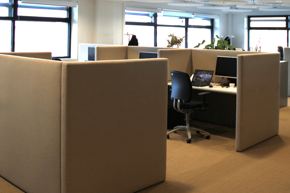
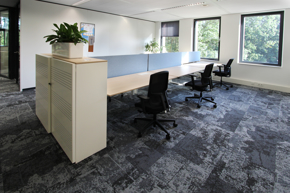
Sedus secretary desk. It features an anthracite fabric membrane all around for privacy. It has two wheels on the back for easy movement. It also includes a metal magnetic board. Dimensions: 120cm wide, 70cm deep, and 110cm high (72cm high to the tablet).
424,00 € incl tax
6 in stock

TR - Steelcase Flex table
Steelcase Flex table of 140x80cm with white top and turquoise frame. The table has 2 large wheels for easy moving. Table includes felt cable carrier.
190,00 € incl tax
768,00 € incl tax
8 in stock

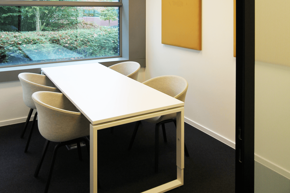
TR - Table 160x80cm light grey
Table with white frame and light grey HPL tabletop. Including built-in electrification.
Dimensions: 160x80 cm. Height adjustable manually.
Can be used as a workstation or meeting table.
145,00 € incl tax
61 in stock

TR - Table 160x80cm white
Fully white table with HPL tabletop.
Dimensions: 160x80 cm. Height adjustable manually.
Can be used as a workstation or meeting table.
145,00 € incl tax
18 in stock

TR - Table 200x80cm
Black metal A-frame with a solid wood tabletop.
Dimensions: 200x80 cm.
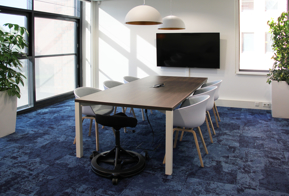
Can be used as a workstation or a meeting table for up to 6 people.
480,00 € incl tax
1 in stock

TR - Sled-base meeting chair
Meeting chair with grey sled base and fixed armrests.
Backrest black plastic with perforations. Dark blue seat.
125,00 € incl tax
4 in stock

TR - Sled-base meeting chair
Meeting chair with grey sled base and fixed armrests.
Backrest black plastic with perforations.
125,00 € incl tax
1 in stock

TR - Sled-base meeting chair
Meeting chair with grey sled base and fixed armrests.
Backrest and seat upholstered with anthracite fabric.
125,00 € incl tax
31 in stock

TR - Sled-base meeting chair
Meeting chair with grey sled base and fixed armrests.
Backrest and seat upholstered with anthracite fabric.
175,00 € incl tax
8 in stock

TR - Sled-base meeting chair
Conference chair with chrome sled leg and fixed armrests.
Backrest and seat upholstered with green fabric.
75,00 € incl tax
4 in stock

TR - Black meeting chair
Black meeting chair with sled base and armrests.
125,00 € incl tax
22 in stock

TR - Black meeting chair
Black meeting chair with sled base and armrests.
75,00 € incl tax
18 in stock

TR - Sit/stand desk 160cm
Workstation with white T-frame and white HPL tabletop.
160 cm wide and 80 cm deep, height adjustable electrically.
580,00 € incl tax
725,00 € incl tax
8 in stock

TR - Sit/stand desk 200cm
Workstation with grey T-frame and HPL wood look tabletop.
200 cm wide and 90 cm deep, height electrically adjustable.
725,00 € incl tax
27 in stock

VD - Brno Chair - Knoll - Flat bar
The Brno Chair, designed by Mies van der Rohe for Knoll, is the 'flat bar' model and is upholstered in antracit leather.
The retail price is between €2,122.07 and €2,865.64. Its dimensions are 80.01 cm high, 57.79 cm wide, and 57.15 cm deep.
475,00 € incl tax
2.844,00 € incl tax
2 in stock

VD - Brno Chair - Knoll - Tubular
The Brno Chair, designed by Mies van der Rohe for Knoll, is the tubular model and is upholstered in white leather.
The retail price is between €2,122.07 and €2,865.64. Its dimensions are 80.01 cm high, 57.79 cm wide, and 57.15 cm deep.
475,00 € incl tax
2.122,00 € incl tax
22 in stock

VD - Giroflex custom design
This chair is a vintage office chair, designed by Martin Stoll for the Swiss brand Giroflex, likely produced in the 1970s. It is part of a line of ergonomic office chairs known for their high-quality design and comfort.
This specific chair was custom-made for a former client and therefore deviates from the usual design. It was designed to complement auditorium seating.
1.800,00 € incl tax
2 in stock

VD - Reverse Chair - Andrea Branzi for Cassina
Klismos lounge chair designed by Antonio Citterio for PTMC around 1990. The frame is made of beech wood, upholstered in woven leather, and the tapered legs are finished with aluminum caps on the bottom.
The dimensions are 61 cm high, 69 cm wide, and 66 cm deep. Seat height 43 cm.
625,00 € incl tax
10 in stock

VD - Reverse Chair - Andrea Branzi for Cassina
Reverse chair designed by Andrea Branzi for Cassina in 1990. It features continuous curved wooden arms and a backrest.
The dimensions are 66cm wide, 50cm deep, and 73cm high.
575,00 € incl tax
19 in stock

VD - Swan chair - Fritz Hansen
Arne Jacobsen for Fritz Hansen Model 3320 Swan Chair. The Swan Chair, "Svanen" model 3320, one of the first chairs produced under the term "organic modernism," was designed and introduced to the public in 1958 by Danish icon Arne Jacobsen. Today, the chair is considered one of the most iconic pieces in furniture history and is still produced by Fritz Hansen, Denmark—one of the world's most recognizable manufacturers of designer furniture, focusing on both public and private spaces.
2.905,00 € incl tax
2 in stock


DL - BULO desk 140cm
BULO H2O desk with white HPL tabletop, including built-in electrification.
Dimensions: 140x70x74cm.
140,00 € incl tax
4 in stock

KB - Moooi standing lamp
‘Light Shade Shade’ is a one way mirror that reflects its environment as well as concealing the chandelier within. When the light is turned on, the ‘Light Shade Shade’ reveals its unforeseen identity and projects the former beauty that lies within.
Designer Jurgen Bey (Droog design) Year of design 1999
Material Semi-transparant mirror film shade, metal frame structure. Dimensions (HxWxD) cm. 187 x 52 x 52
303,00 € incl tax
20 in stock
